
AI model release tracker
Every AI model release as an arrival at an airport. A runway you scroll back through release by release, and a split-flap board of the whole catalog with prices, context windows and full specifications.
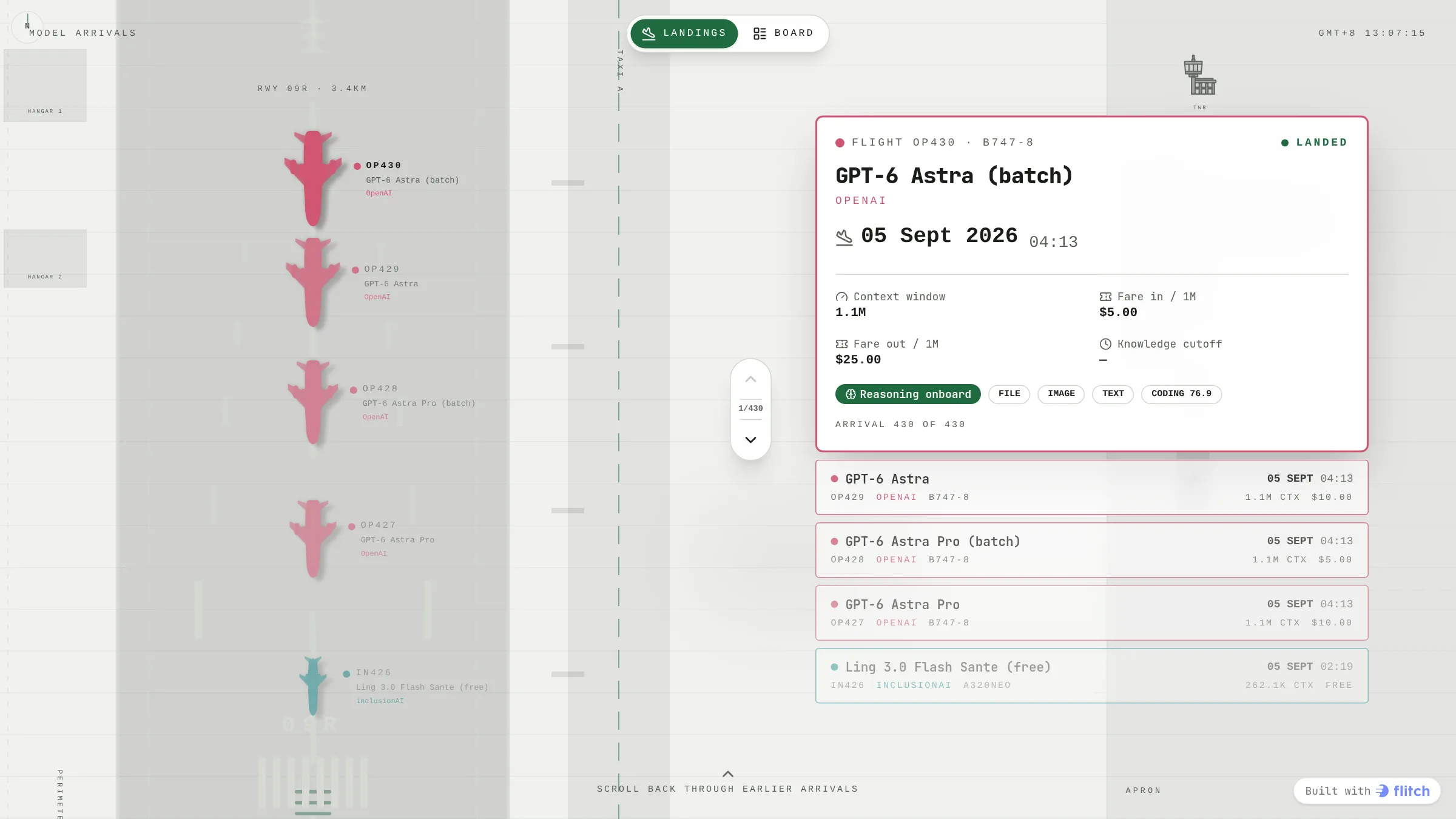
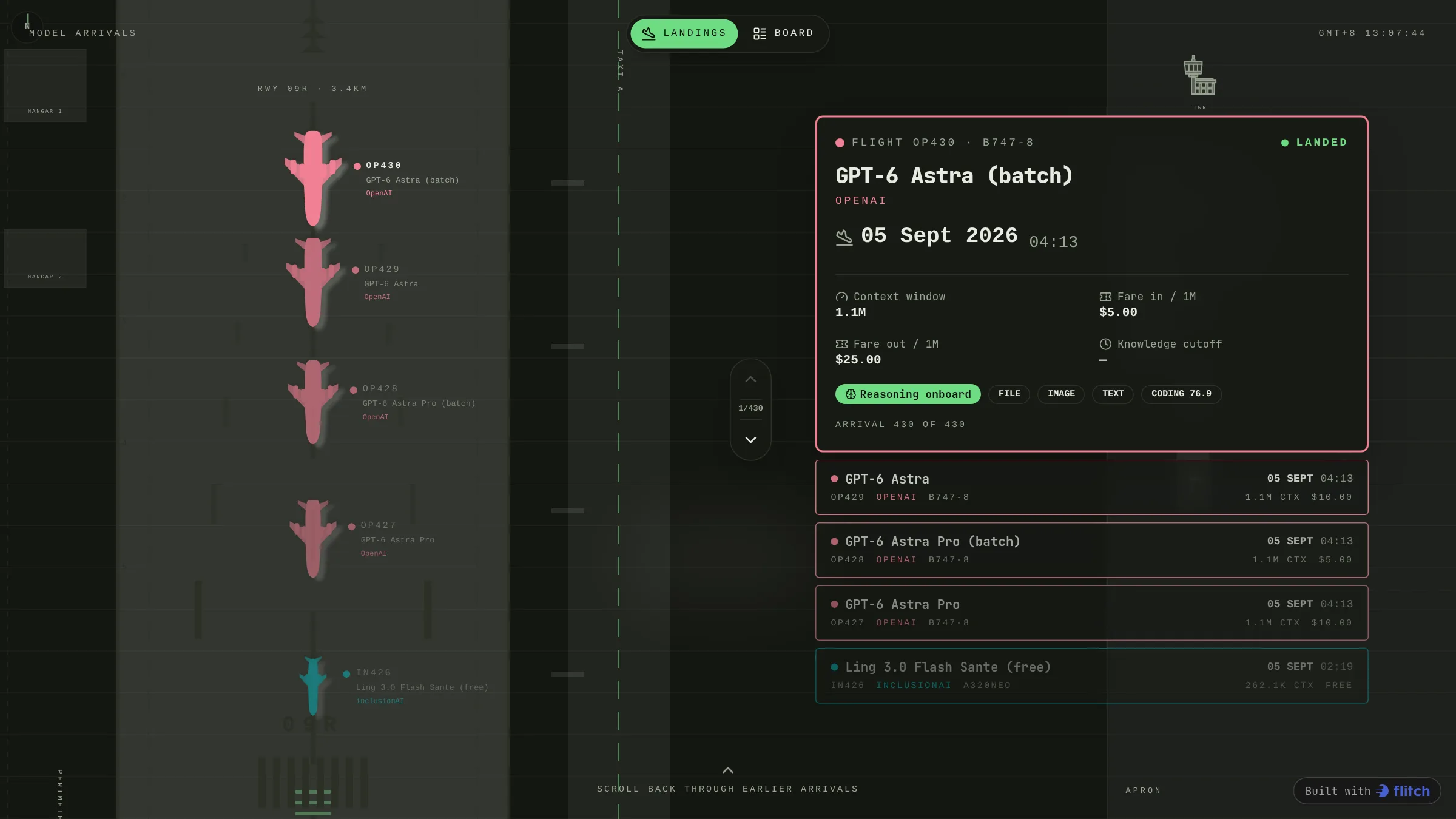
A working dashboard built in Flitch on OpenRouter’s public models endpoint. It draws each release as an aircraft landing on a runway you scroll through, newest first, and switches to a departures-board view listing every model with its prices, context window and specifications. Copy it and it fills immediately, with no key to paste.
What the dashboard does
- A runway as the page itself, scrolled a release at a time, newest arrival at the front
- Every model as an aircraft in its provider’s own livery, the airframe deterministic per provider so a carrier always flies the same shape
- A detail card for the arrival at the front: release date and time, context window, price in and out per million tokens, knowledge cutoff, reasoning support and top benchmark
- The four arrivals still on the strip behind it, each on its own card with flight number, carrier and fare
- A split-flap departures board of the whole catalog, newest first, flapping into place as it loads
- Search by model, provider or model id, and filters for provider, reasoning support and modality
- Any row on the board expands to full specifications: model id, context window, cutoff, retirement date, all four prices, input types and supported parameters
- Input, output, cache-read and cache-write prices side by side per million tokens, with free models marked as such
- Models past their retirement date marked Expired rather than dropped, so the history stays complete
- A clock in whichever time zone the reader is in, and release times rendered in it
What data sits behind it
| Dataset | What it carries |
|---|---|
| OpenRouter Models API - List all available models | One row per model: provider, release date, context window, pricing, architecture, supported parameters, benchmarks and retirement date. |
How it was built
Nobody laid this out by hand. It came from one prompt, against the datasets above, and was refined from there. This is the prompt, unedited.
Build an airport-themed dashboard showing AI models as arrivals ordered by release date. Include a scrollable timeline view where each model appears as a landing event with its details (provider, pricing, context length, architecture, reasoning support) revealed as the user scrolls through release history. Add a toggle to switch to a departures-board style view listing models with release date as arrival time, expandable on click to show full specifications. The dashboard should present models in chronological order from oldest to newest release.
AI model release tracker FAQ
Where does the data come from?
OpenRouter’s public models endpoint, which lists the models it can route to along with their pricing, context windows and capabilities. About 430 of them today, and the number moves every time a provider ships. Nothing here is hand maintained.
Do I need an API key to use it?
No. The endpoint is public, so the copy arrives already pointed at it with nothing to paste, which is unusual for a template built on a live source. It also arrives refreshing once a day, so a copy taken today still has the right models on it next month without anyone going back to it. Change the schedule, or stop it, in the dataset’s settings.
Are the flight numbers and aircraft real?
No, and they are not random either. The flight number, the livery colour and the airframe are all derived from the provider’s name, so one provider always flies the same shape in the same colour and you can pick its releases out of the board at a glance. Only the dates, prices and specifications come from the feed.
What does Expired mean on a row?
The feed carries a retirement date for models a provider has announced an end for. Anything past it is marked Expired and stays on the board rather than disappearing, because a model that has been withdrawn is still part of the release history you are reading.
Can I point it at something other than model releases?
Yes. What it really is, underneath the airport, is a way of reading any dated feed as a sequence of arrivals. Swap the dataset for another API with a date per row and the runway, the board and the filters all follow it.
Start from this one
You get your own copy, with its own data, in your own space. Change anything you like.
Use this template